Understanding Shodō – history, script and artistic expression
6 min read · Published
In short
Shodō (書道) is the Japanese art of writing with brush and ink. It builds on script adopted from China, developed its own forms with kana, and today ranges from classical practice to free, image-like works.
What does Shodō mean?
Shodō combines the characters 書 (sho, to write, writing) and 道 (dō, way). It refers to writing with a soft brush and ink — not merely to transmit a text but as an activity in which form, movement and attitude matter. In English it is usually called Japanese calligraphy; the term is useful, though it does not fully match the European idea of “beautiful handwriting”.
The Metropolitan Museum stresses exactly this: East Asian brush writing both encompasses and transcends the Western notion of “calligraphy”. Traditionally, handwriting was seen as a sign of education and aesthetic judgement — acquired by copying revered models and by creative innovation. Beauty could at times matter more than easy legibility.[1]
Where did the script come from? Chinese origins and Japan
In its early history Japan had no writing system of its own. It adopted a fully developed one from China — together with Buddhist teachings, from the sixth century onward. Although Japanese and Chinese have little in common as languages, official and religious texts were at first written in Chinese. Along with script came Buddhist art and artists from the continent.[1]
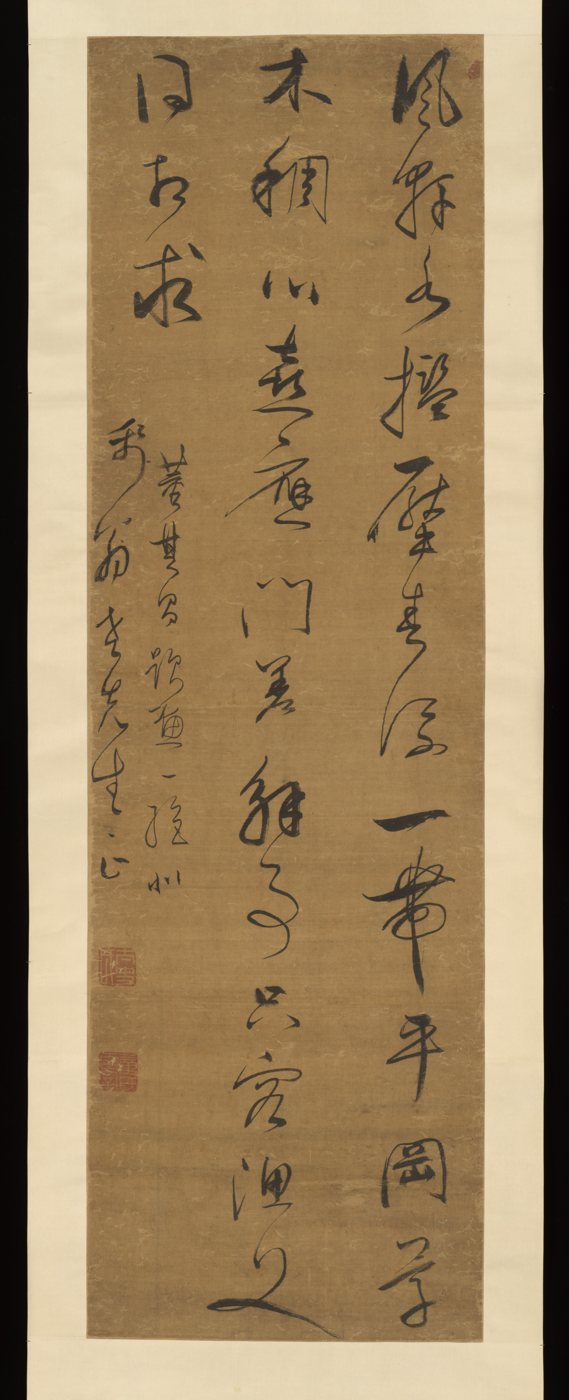
Even later, Chinese remained the preferred language for administration, scholarship and religion; a Chinese inscription carried authority and dignity. Chinese formats such as handscrolls and fans were also adopted. Looking at China therefore remains important for understanding Japanese calligraphy — without Shodō being simply a copy of Chinese calligraphy.[1]
Kanji and kana: script, language, reading and meaning
Japanese calligraphers could write in kanji (Chinese characters), kana (Japanese phonetic signs) or both, depending on the text. Kana developed from highly cursive forms of Chinese characters and by the tenth century had become a distinct system with its own aesthetic priorities. Kanji appear denser and more complex, kana rounder and more flowing. By the tenth century court calligraphers were already experimenting with harmonising the two.[1]
When looking, a distinction helps: the script is the visible sign; the language is what is written; the reading is the pronunciation; the meaning is the content. A kanji such as 光 can be read differently in Japanese (for example hikari or kō) while keeping its core meaning “light”. Historical kana texts are also hard to decipher: many characters differ from today's forms, and one sound could be written with several variants. Only at the end of the nineteenth century did publishers adopt standardised kana.[1]
Court culture, poetry and religious practice
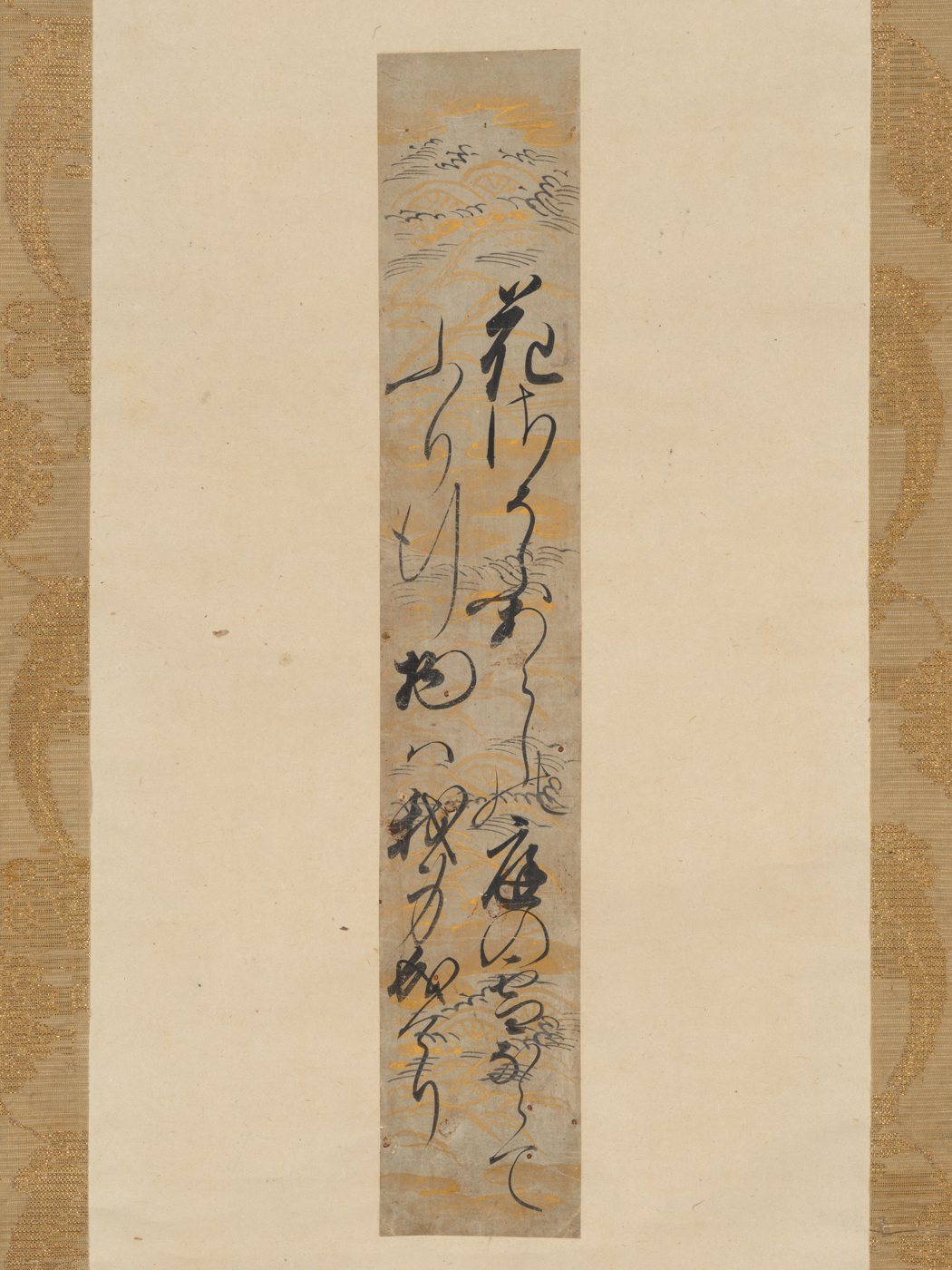
At the Japanese court a practised hand was a mark of culture. Diaries of the Heian period (794–1185) show the enthusiasm with which courtiers and court ladies exchanged poems and letters in elegant script. Kana — then also called onna-de, the “women's hand” — enabled waka poetry and new genres in Japanese. Dedicated formats emerged for poems: square shikishi, tall narrow tanzaku and kaishi sheets.[1]
Religious contexts also shaped esteem for the written word. Copying Buddhist sutras was considered meritorious; splendid sutra copies in gold and silver bear witness to this. In medieval Zen circles boldly brushed characters emerged that deliberately broke conventions. Such writings by Zen monks, bokuseki (“ink traces”), were particularly prized at tea gatherings in the display alcove (tokonoma).[1]
Kaisho, gyōsho, sōsho: the classical script styles
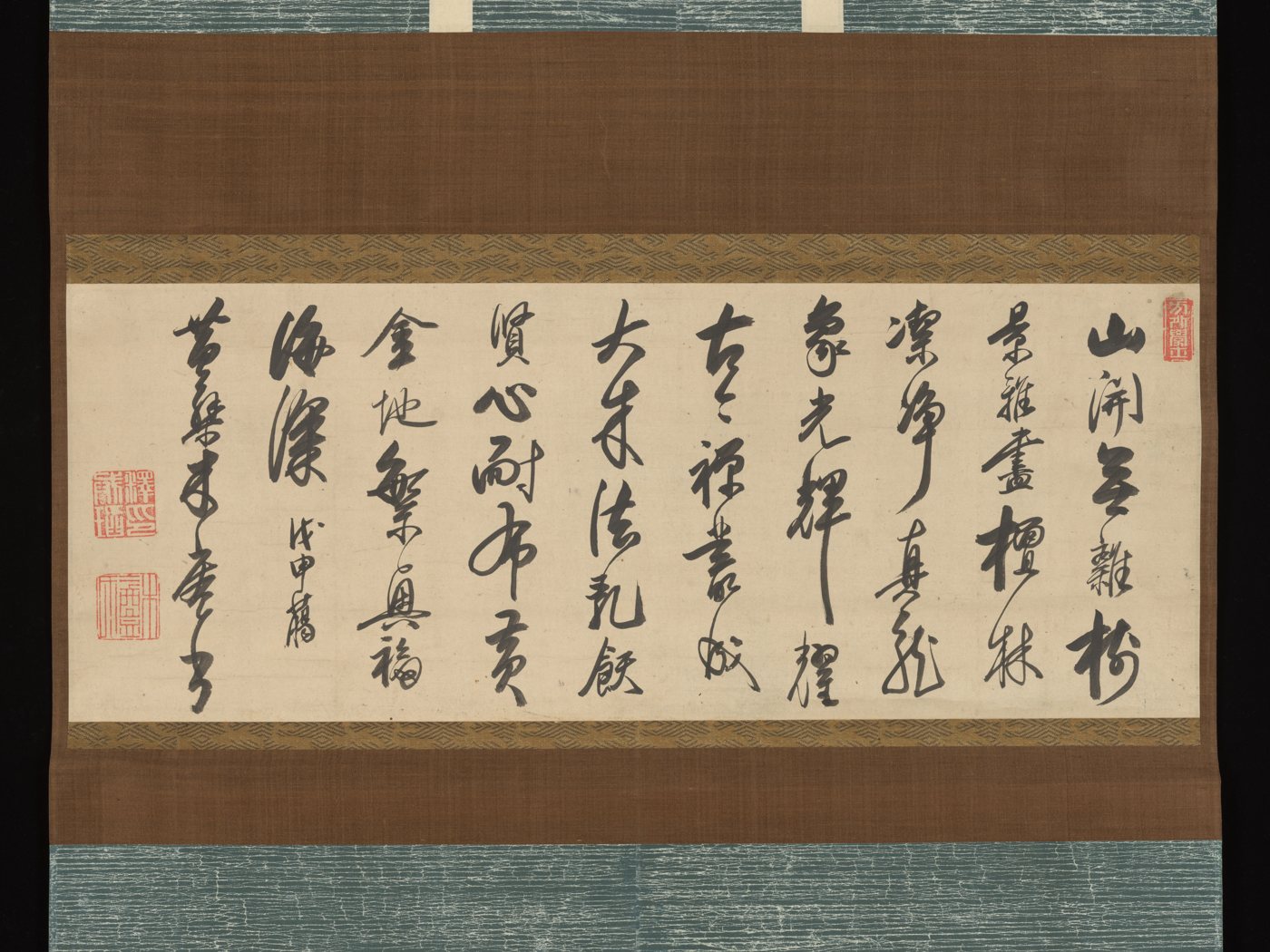
Chinese characters can be written in various scripts that differ by degree of cursiveness and abbreviation. Three basic types are especially common: standard script (kaisho), semi-cursive (gyōsho) and cursive (sōsho). There are also older styles such as seal and clerical script, which are not covered in depth here.[1]
For viewers, correct classification matters less than what the style makes visible: standard script reveals structure and balance, cursive reveals tempo and connection. Many works move between these poles.
Writing exercise, personal practice and independent art
Shodō covers very different things. It often begins with copying models — historically, copying revered exemplars. This can grow into a personal practice cultivated for years without ever exhibiting work. Independent artistic work begins where a person deliberately decides on character, format, ink density, composition and empty space, and presents the result as a work.[1]
Modern and contemporary calligraphy
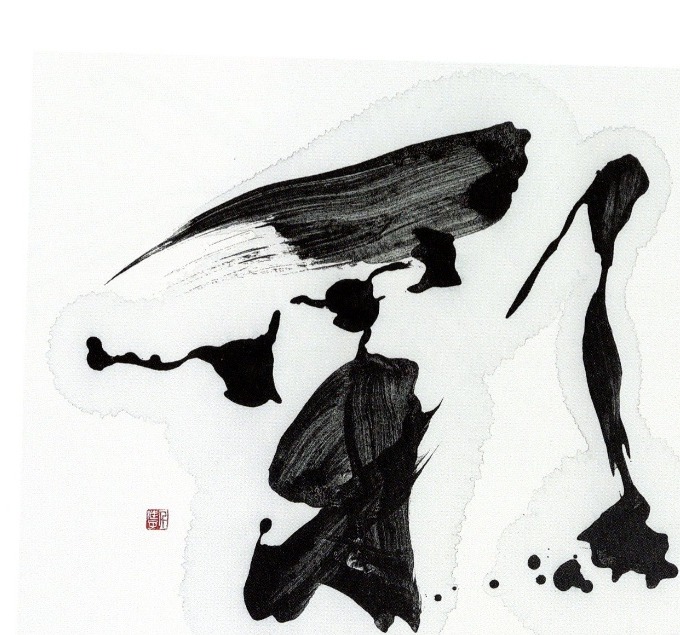
In the twentieth century some calligraphers moved further away from legibility, working with large single characters, forceful gestures and open fields. Museums now collect such works as art of their time: the Metropolitan Museum lists, for example, Inoue Yūichi's “Kanzan” (1966, ink on Japanese paper) and Shinoda Tōkō's “Words of Gold” (2011, ink on gilded paper). The exhibition “Brush Writing in the Arts of Japan” accordingly spanned from the eleventh century to the present.[2][3][1]
How can you look at calligraphy without reading Japanese?
The Metropolitan Museum describes how each work reveals the original movement: the pressure, speed and rhythm of the brush. One example from court culture is chirashigaki, “scattered writing”: lines are deliberately offset to create an engaging arrangement of ink lines and blank spaces — the eye lingers and reads more slowly.[1]
Process
- StrokeWhere is the line saturated, where dry and broken? Where does the brush land, where does it lift?
- RhythmFollow the order of strokes: where does it speed up, where is there a pause?
- Empty spaceThe unwritten paper is part of the composition, not background.
- CompositionHow do character, signature and seal relate to one another and to the format?
Shodō and sumi-e: what is the difference?
Both use brush, sumi and paper, but they are different terms. Shodō is the art of writing: its starting point is a character or text. Sumi-e (墨絵) means ink painting: its starting point is an image such as a landscape, plant or figure. Historically the two often meet — the Metropolitan Museum mentions ink landscapes inscribed with Chinese poems, a genre called shigajiku (“hanging scrolls with poems and paintings”).[1]
Questions and answers
- Is Shodō the same as Japanese calligraphy?
- In everyday use, yes. Strictly speaking, Shodō covers more than “beautiful writing”: movement, composition and the writer's attitude are part of it.
- Do I need to read a work to appreciate it?
- No. Stroke, rhythm and empty space can be appreciated without knowing the language. SumiFox gives the character, reading and meaning for each work.
- Is Shodō always connected with Zen?
- No. Zen calligraphy is one important strand, alongside court poetry, sutra copying, administration and modern art.
Read on
Sources
- The Metropolitan Museum of Art, New York: Brush Writing in the Arts of Japan (Ausstellung / exhibition, 17.08.2013–12.01.2014). https://www.metmuseum.org/exhibitions/listings/2013/brush-writing (accessed 11 October 2026)
- The Metropolitan Museum of Art, New York: Inoue Yūichi, “Kanzan” (Hanshan), 1966 – Sammlungseintrag / collection record. https://www.metmuseum.org/art/collection/search/655752 (accessed 11 October 2026)
- The Metropolitan Museum of Art, New York: Shinoda Tōkō, Words of Gold, 2011 – Sammlungseintrag / collection record. https://www.metmuseum.org/art/collection/search/78184 (accessed 11 October 2026)
- The Metropolitan Museum of Art, New York: Open Access at The Met. https://www.metmuseum.org/hubs/open-access (accessed 11 October 2026)
Image credits
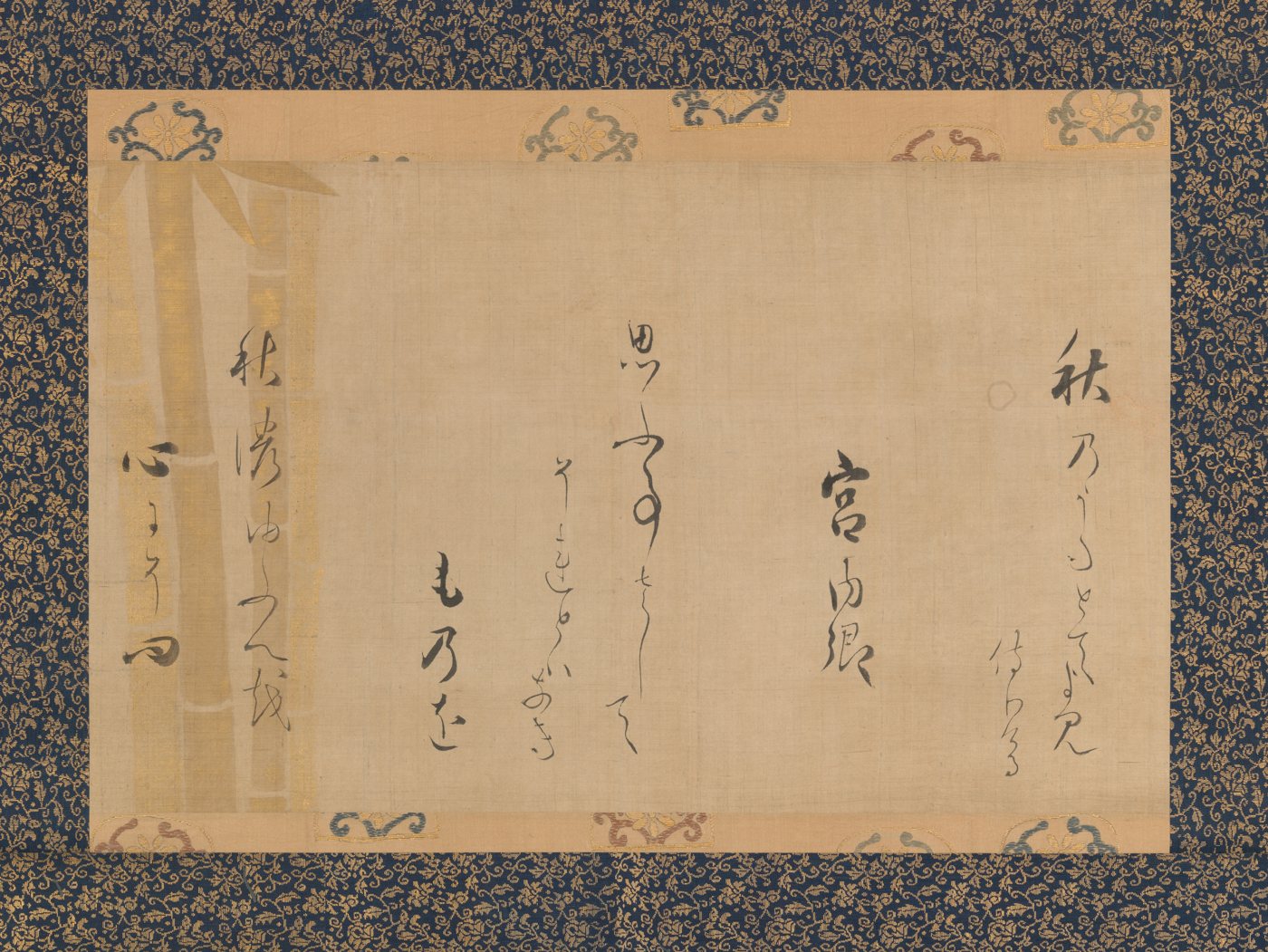
- Hon'ami Kōetsu, Autumn Poem by Lady Kunaikyō, mid-1620s — Hon'ami Kōetsu (1558–1637); The Metropolitan Museum of Art, Gift of Florence and Herbert Irving, 2015, 2015.500.9.46.
Source: https://www.metmuseum.org/art/collection/search/78165
Licence: CC0 1.0 (Met Open Access) · The Metropolitan Museum of Art, New York (Public Domain)
Edits: Resized and re-compressed as JPEG; not cropped, colours unchanged. · checked 11 October 2026 - Dong Qichang, Poem in Cursive Script, ca. 1622–25 — Dong Qichang (1555–1636); The Metropolitan Museum of Art, Gift of Douglas Dillon, 1979, 1979.500.3.
Source: https://www.metmuseum.org/art/collection/search/48955
Licence: CC0 1.0 (Met Open Access) · The Metropolitan Museum of Art, New York (Public Domain)
Edits: Resized and re-compressed as JPEG; not cropped, colours unchanged. · checked 11 October 2026 - Emperor Go-Yōzei, Waka Poem, late 16th–early 17th century — Kaiser Go-Yōzei / Emperor Go-Yōzei 後陽成天皇 (1571–1617); The Metropolitan Museum of Art, Mary and Cheney Cowles Collection, 2020, 2020.396.15.
Source: https://www.metmuseum.org/art/collection/search/845136
Licence: CC0 1.0 (Met Open Access) · The Metropolitan Museum of Art, New York (Public Domain)
Edits: Resized and re-compressed as JPEG; not cropped, colours unchanged. · checked 11 October 2026 - Mu'an Xingtao (Mokuan Shōtō), Poem Celebrating the Great Buddha Hall of Manpukuji, 1668 — Mu'an Xingtao / Mokuan Shōtō (1611–1684); The Metropolitan Museum of Art, Mary and Cheney Cowles Collection, 2025, 2025.795.9.
Source: https://www.metmuseum.org/art/collection/search/929159
Licence: CC0 1.0 (Met Open Access) · The Metropolitan Museum of Art, New York (Public Domain)
Edits: Resized and re-compressed as JPEG; not cropped, colours unchanged. · checked 11 October 2026 - Takemura Chikako, 彩, 2019 — Takemura Chikako 竹村千佳子.
Source: SumiFox
Licence: © Takemura Chikako – alle Rechte vorbehalten / all rights reserved · © Takemura Chikako; Abbildung für SumiFox bereitgestellt
Edits: Cropped for SumiFox presentation; seals retained. · checked 11 October 2026