Brush, paper and inkstone – the tools of Shodō
5 min read · Published
In short
Shodō works with four basic tools: brush, ink, inkstone and paper. Their interplay — how much ink the brush holds, how finely it is ground and how strongly the paper absorbs — decides what a line looks like. This article explains the tools; the ink itself is covered in the sumi article.
The four treasures of the study
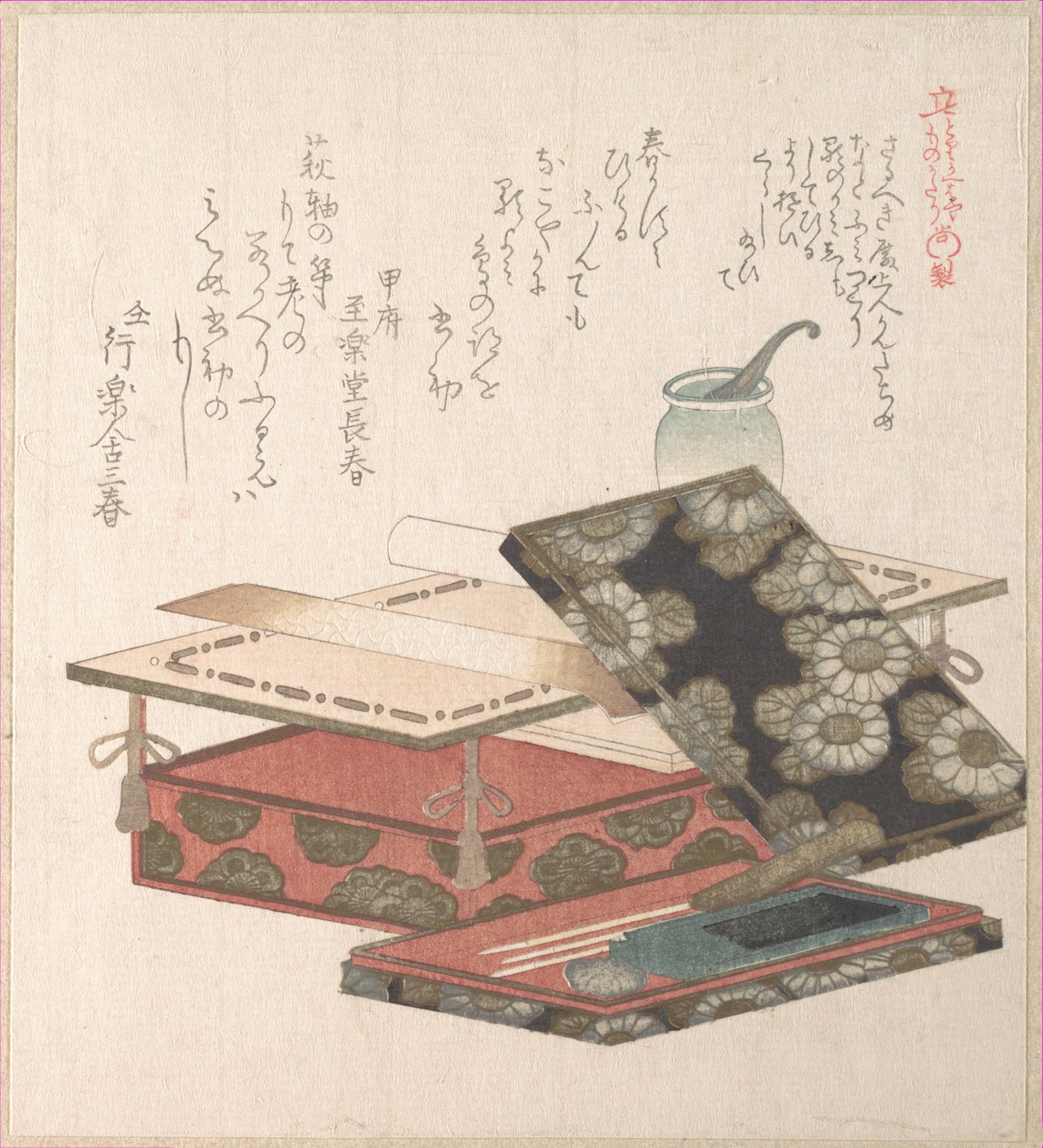
Brush, ink, inkstone and paper are grouped in East Asia as the “four treasures of the study” (文房四宝, bunbō shihō). Japan's Agency for Cultural Affairs explicitly named their use as a principle of Shodō when it registered calligraphy as an intangible cultural property in 2021. The four are not mere equipment: each changes what becomes visible on paper.[1]
Tool overview
- Fude – brush
- Sumi – ink stick
- Suzuri – inkstone
- Kami – paper
- Bunchin – paperweight
- Shitajiki – felt underlay
- Suiteki – water dropper
Fude – the brush
A fude consists of the hair bundle (hokubi) and the handle (jiku). The description of the traditional Kumano brush craft from Hiroshima distinguishes, from tip to base, the zones inochige, nodo, hara and koshi. Hairs of different lengths are cut and blended so the bundle forms a point, takes up ink and springs back after pressure.[2][3]
Anatomy of a brush
- Inochige – the very tip
- Nodo – upper tip area
- Hara – belly, holds the ink
- Koshi – base, gives spring
- Jiku – handle (bamboo or wood)
For the hair, the Kumano brush standard lists goat, horse, deer, raccoon dog, weasel or cat among others; the handle is bamboo or wood. Soft hair such as goat holds a lot of ink and releases it evenly; stiffer hair springs back more and allows sharper entries. Many brushes blend both. Bundle size and length range from small brushes for names and fine kana to large brushes for single characters on big sheets.[2][3]
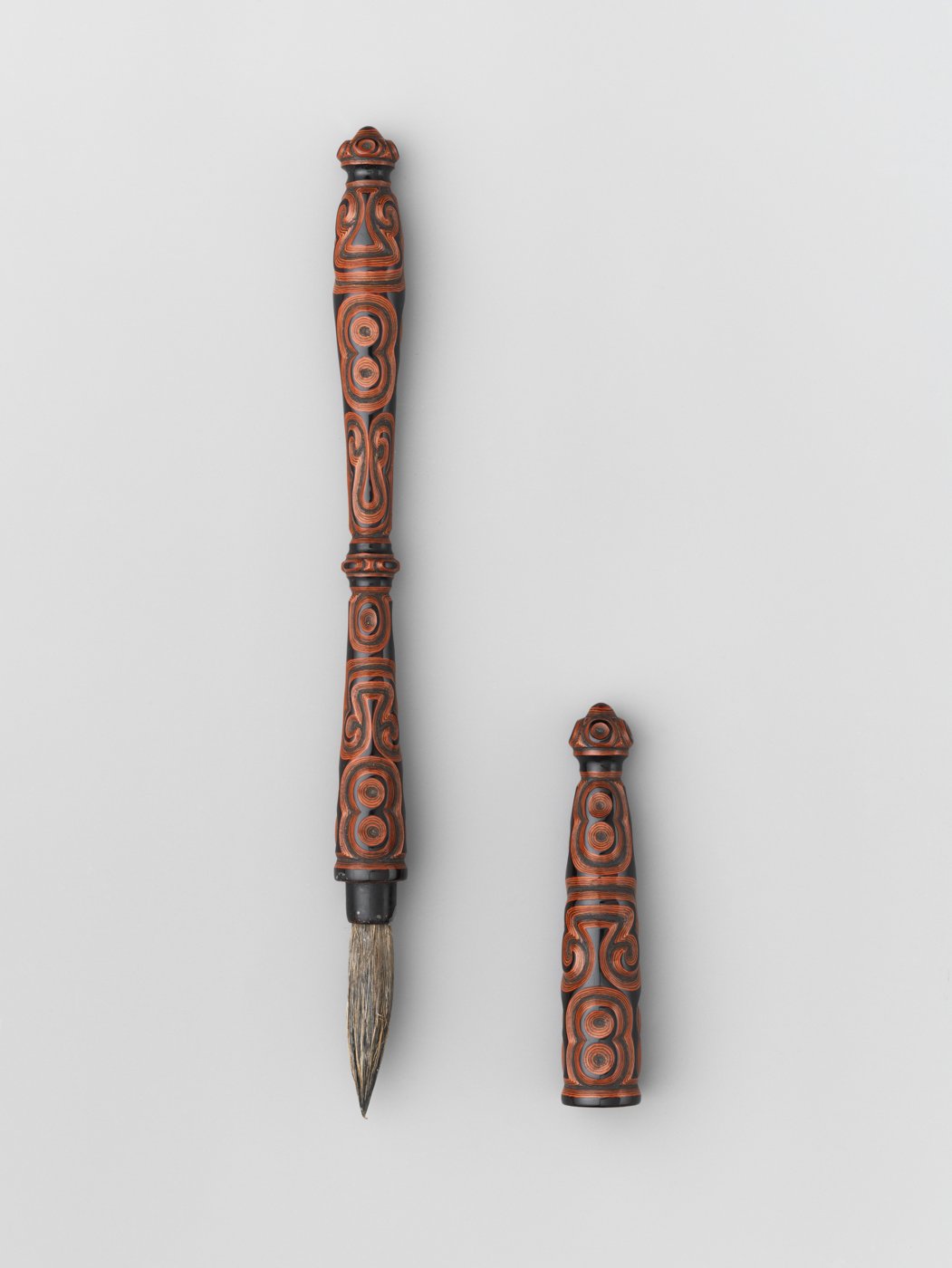
In a finished work you do not see the brush itself, but its traces: whether a line starts with a fine point, whether it lies broad, whether single hairs leave visible streaks in a fast movement. Which brushes our artists used for a given work is not documented — so for works we describe only what is visible.
Suzuri – the inkstone
On the suzuri the ink stick is ground with a little water. The flat grinding surface (oka) is slightly rough so that soot and glue come off the stick; the finished ink collects in the hollow (umi, “sea”) and stays ready. The length of grinding and the amount of water set the ink's density. Water is often added from a small vessel, the suiteki, drop by drop.
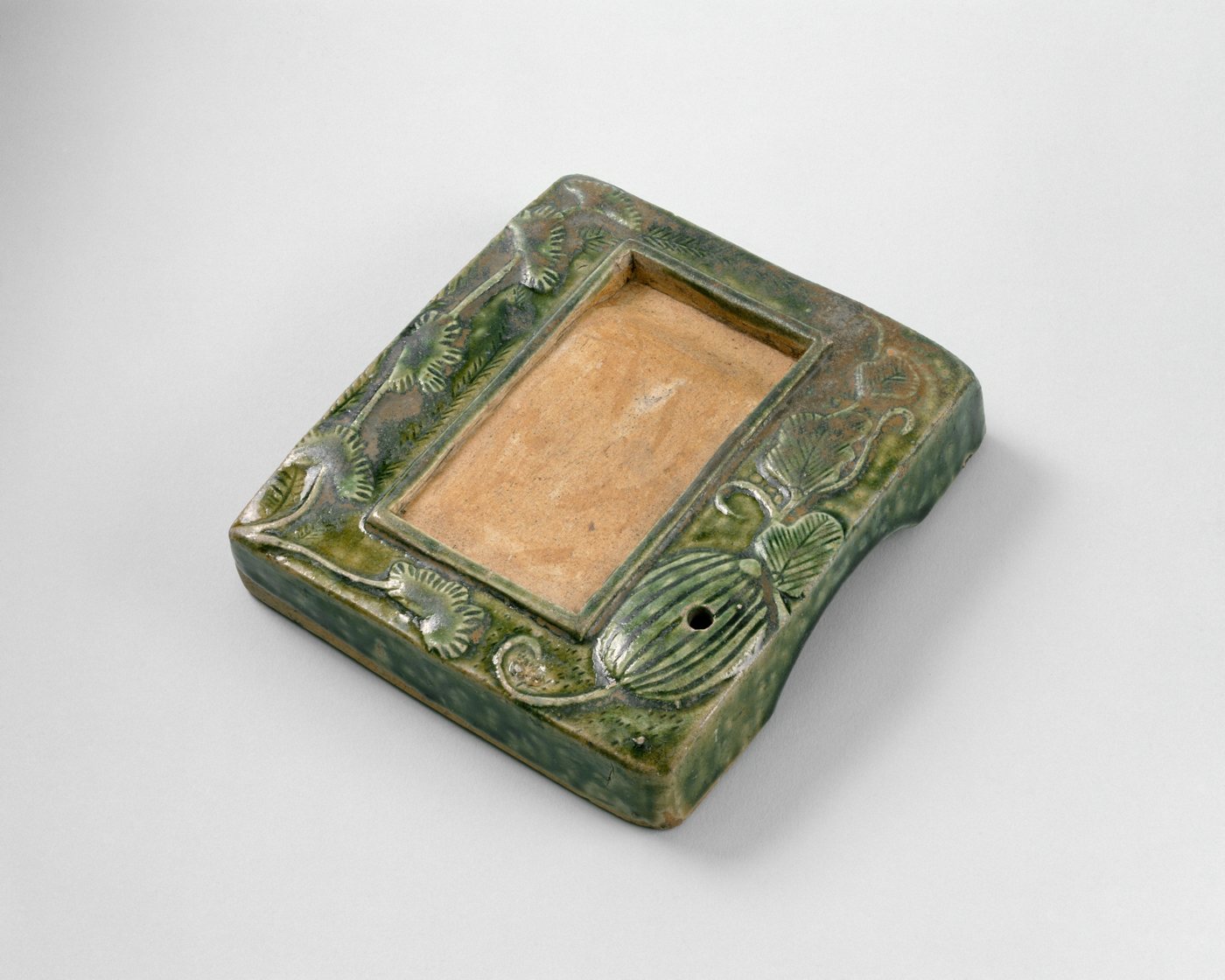
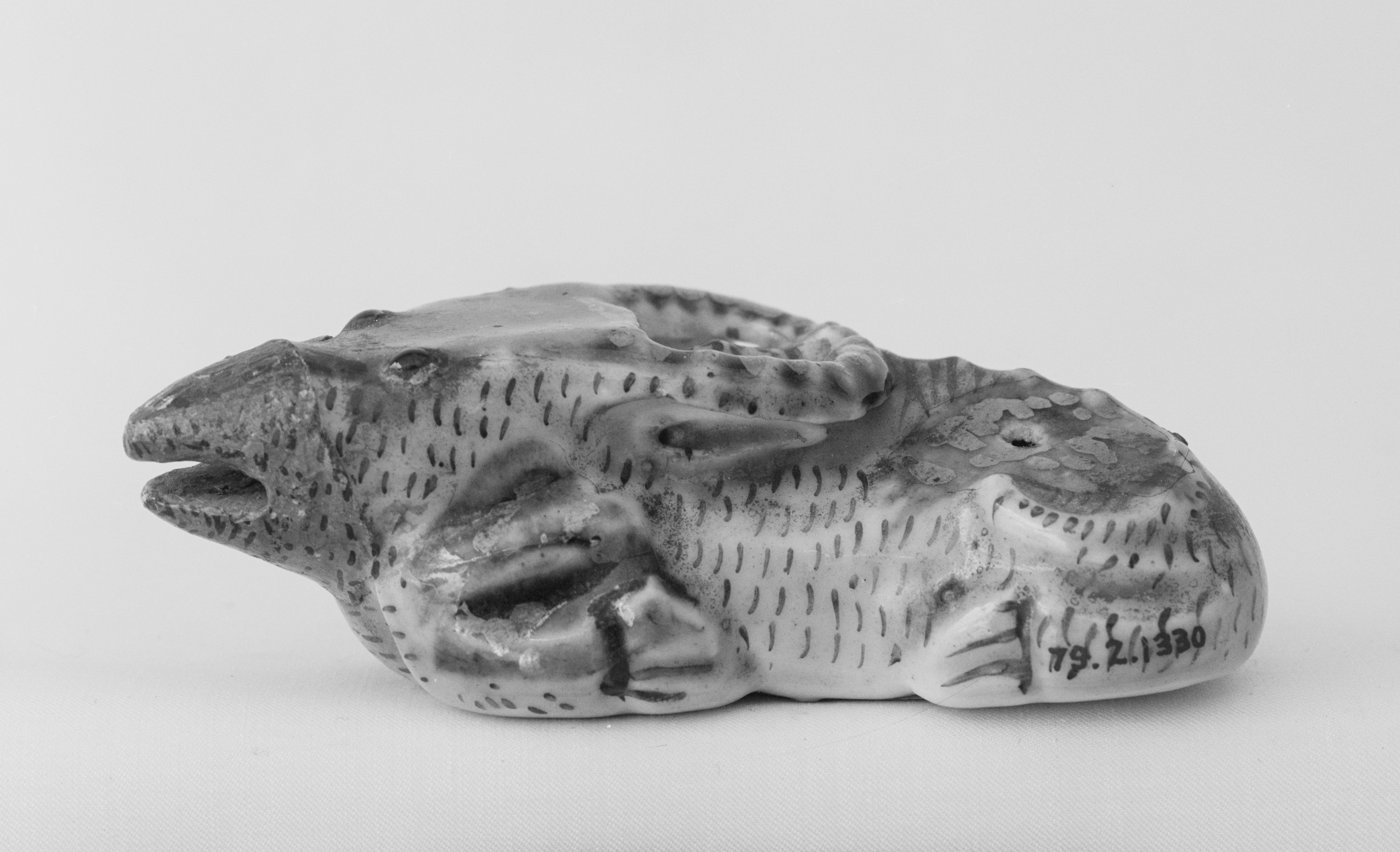
How ink is made — from soot, glue, kneading, moulding and long drying — is explained in detail in the article “Sumi – material, making and use of Japanese ink”. For understanding the tools it is enough to know: ground stick ink and ready-made liquid ink behave differently, and the inkstone is the tool with which you adjust the ink yourself.
Paper and washi
Paper is the part of the work that remains. Three properties matter: the surface (smooth or fibrous), absorbency (how quickly water and ink penetrate and spread) and fibre structure (long fibres make a sheet tough and let ink travel differently from short ones). Highly absorbent paper records every hesitation of the brush; less absorbent paper lets the ink sit longer on the surface.
“Washi” is often used for any Japanese paper. More precisely, washi refers to paper made in Japan by traditional methods, especially from bast fibres such as kōzo (paper mulberry). In 2014 UNESCO inscribed the craftsmanship of hand-made washi, represented by three papers — Sekishū-banshi, Hon-minoshi and Hosokawa-shi — as intangible cultural heritage. Many practice and calligraphy papers, by contrast, are machine-made or use other fibres. We therefore call a paper hand-made washi only when this is documented.[4]
Underlay, paperweight and water dropper
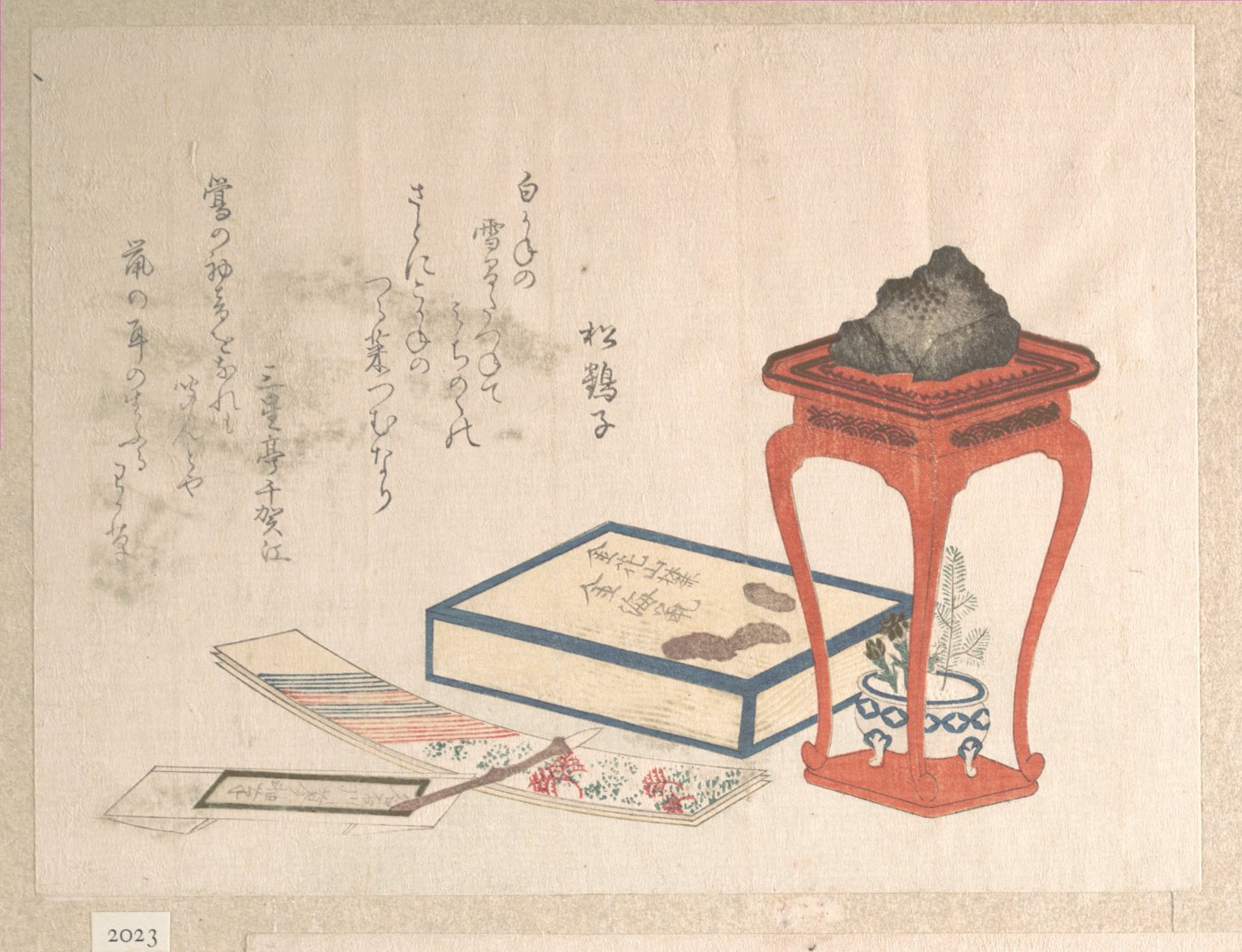
Under the paper there is usually a felt underlay (shitajiki). It absorbs ink that soaks through and gives the brush an elastic resistance. A paperweight (bunchin) holds the sheet so it need not be fixed by hand. The suiteki doses water for the inkstone. Add brush rests and holders in which brushes dry. These things are simple, but they decide whether one can work calmly and undisturbed.
Interplay and practice
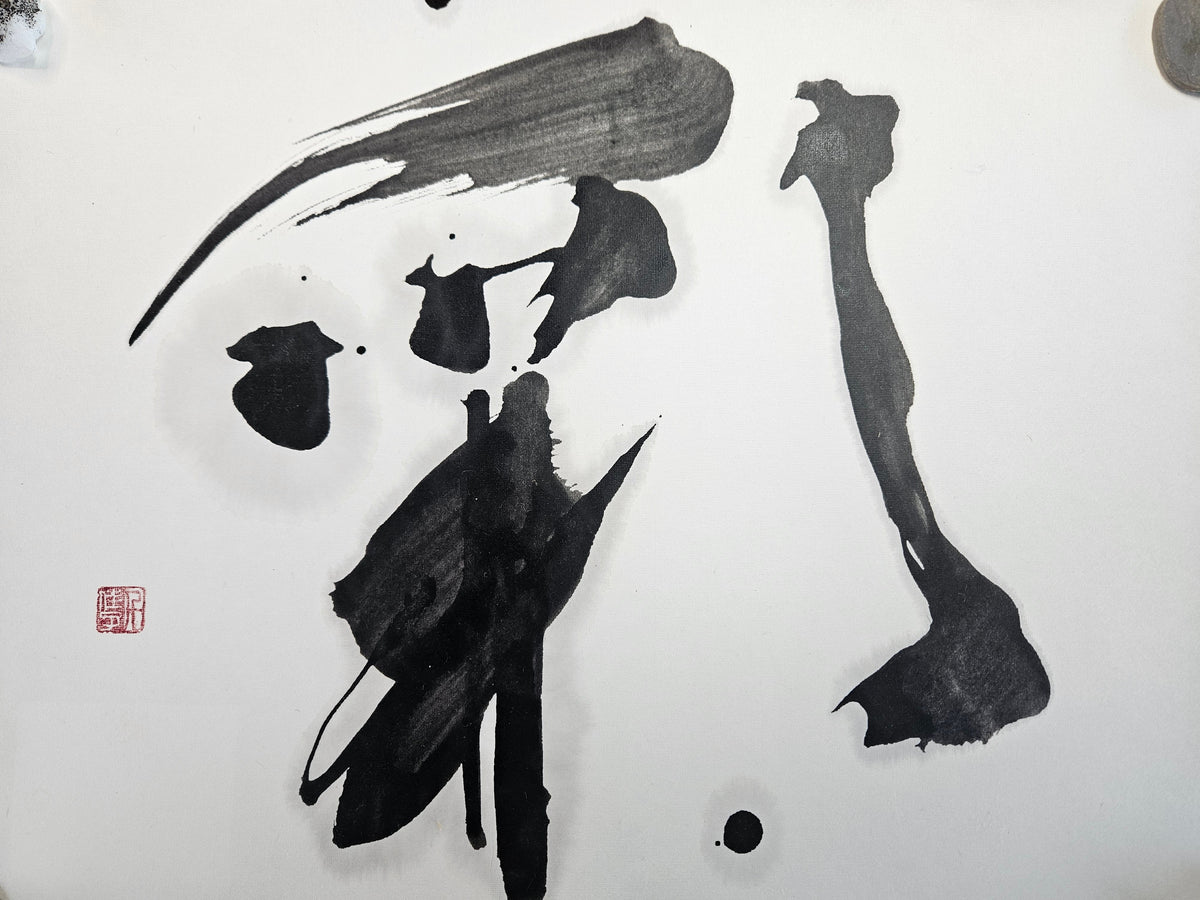
No property acts alone. Much ink in a soft brush on absorbent paper gives broad, spreading edges; little ink and a quick movement produce dry, broken traces (kasure). The same hand produces a different line on different paper. This is why writers often test materials before beginning a work.
Practice and work materials differ in format, price and availability: practice paper is standardised and used in large quantities, while sheets for works are often chosen specifically for format and behaviour. This does not create a fixed ranking of “good – better – best”; what matters is whether material and intention fit together.
Questions and answers
- Is every Japanese calligraphy paper washi?
- No. Washi in the narrower sense is paper traditionally made in Japan, often from kōzo. Many calligraphy papers are machine-made or contain other fibres.
- What are brush hairs made of?
- Traditionally from animal hair such as goat, horse, deer, raccoon dog or weasel, often blended. There are also brushes with synthetic fibres.
- Which materials do the SumiFox artists use?
- For each work we state sumi ink on paper, format and condition. Specific brush or paper makes are not documented, so we do not name any.
Read on
Sources
- 文化庁 / Agency for Cultural Affairs, Japan (広報誌ぶんかる) (吉野亨 Yoshino Tōru): 書道の登録無形文化財への登録について (15.10.2021). https://www.bunka.go.jp/prmagazine/rensai/news/news_004.html (accessed 11 October 2026)
- 熊野筆事業協同組合 / Kumano Brush Business Cooperative: 伝統的工芸品 熊野筆 (Traditional craft Kumano brush). https://www.kumanofude.or.jp/traditional-craft/ (accessed 11 October 2026)Information from the producers' cooperative
- 伝統工芸 青山スクエア (Japan Traditional Craft Center): 熊野筆 – 技術・技法・原材料, 工程. https://kougeihin.jp/craft/1007/ (accessed 11 October 2026)
- UNESCO Intangible Cultural Heritage: Washi, craftsmanship of traditional Japanese hand-made paper (inscribed 2014). https://ich.unesco.org/en/RL/washi-craftsmanship-of-traditional-japanese-hand-made-paper-01001 (accessed 11 October 2026)
- The Metropolitan Museum of Art, New York: Brush Writing in the Arts of Japan (Ausstellung / exhibition, 17.08.2013–12.01.2014). https://www.metmuseum.org/exhibitions/listings/2013/brush-writing (accessed 11 October 2026)
- The Metropolitan Museum of Art, New York: Open Access at The Met. https://www.metmuseum.org/hubs/open-access (accessed 11 October 2026)
Image credits
- Kubo Shunman, Table and Writing Set, 19th century — Kubo Shunman 窪俊満 (1757–1820); The Metropolitan Museum of Art, H. O. Havemeyer Collection, Bequest of Mrs. H. O. Havemeyer, 1929, JP1985.
Source: https://www.metmuseum.org/art/collection/search/54683
Licence: CC0 1.0 (Met Open Access) · The Metropolitan Museum of Art, New York (Public Domain)
Edits: Resized and re-compressed as JPEG; not cropped, colours unchanged. · checked 11 October 2026 - Writing brush with geometric patterns, 13th century — Unbekannt / unidentified, China; The Metropolitan Museum of Art, Gift of Florence and Herbert Irving, 2015, 2015.500.1.22a, b.
Source: https://www.metmuseum.org/art/collection/search/40178
Licence: CC0 1.0 (Met Open Access) · The Metropolitan Museum of Art, New York (Public Domain)
Edits: Resized and re-compressed as JPEG; not cropped, colours unchanged. · checked 11 October 2026 - Inkstone (Suzuri) with Gourd Vine, Mino ware, late 16th–early 17th century — Japan, Momoyama-Zeit / Momoyama period; The Metropolitan Museum of Art, Bequest of Dr. and Mrs. Roger G. Gerry, 2000, 2002.447.29.
Source: https://www.metmuseum.org/art/collection/search/49283
Licence: CC0 1.0 (Met Open Access) · The Metropolitan Museum of Art, New York (Public Domain)
Edits: Resized and re-compressed as JPEG; not cropped, colours unchanged. · checked 11 October 2026 - Water dropper (suiteki), Arita ware, 18th century — Unbekannt / unidentified, Japan; The Metropolitan Museum of Art, Purchase by subscription, 1879, 79.2.1330.
Source: https://www.metmuseum.org/art/collection/search/47044
Licence: CC0 1.0 (Met Open Access) · The Metropolitan Museum of Art, New York (Public Domain)
Edits: Resized and re-compressed as JPEG; not cropped, colours unchanged. · checked 11 October 2026 - Ryūryūkyo Shinsai, Stand, Box and Writing-Paper, probably 1816 — Ryūryūkyo Shinsai 柳々居辰斎 (tätig/active ca. 1799–1823); The Metropolitan Museum of Art, H. O. Havemeyer Collection, Bequest of Mrs. H. O. Havemeyer, 1929, JP2023.
Source: https://www.metmuseum.org/art/collection/search/54772
Licence: CC0 1.0 (Met Open Access) · The Metropolitan Museum of Art, New York (Public Domain)
Edits: Resized and re-compressed as JPEG; not cropped, colours unchanged. · checked 11 October 2026 - Takemura Chikako, 彩① – Colour I, original, sumi on paper, 45.5 × 35.5 cm — Takemura Chikako 竹村千佳子.
Source: SumiFox
Licence: © Takemura Chikako – alle Rechte vorbehalten / all rights reserved · © Takemura Chikako; Werkfoto SumiFox / work photo SumiFox
Edits: Work photo from the SumiFox shop; resized, not cropped, colours unchanged. · checked 11 October 2026